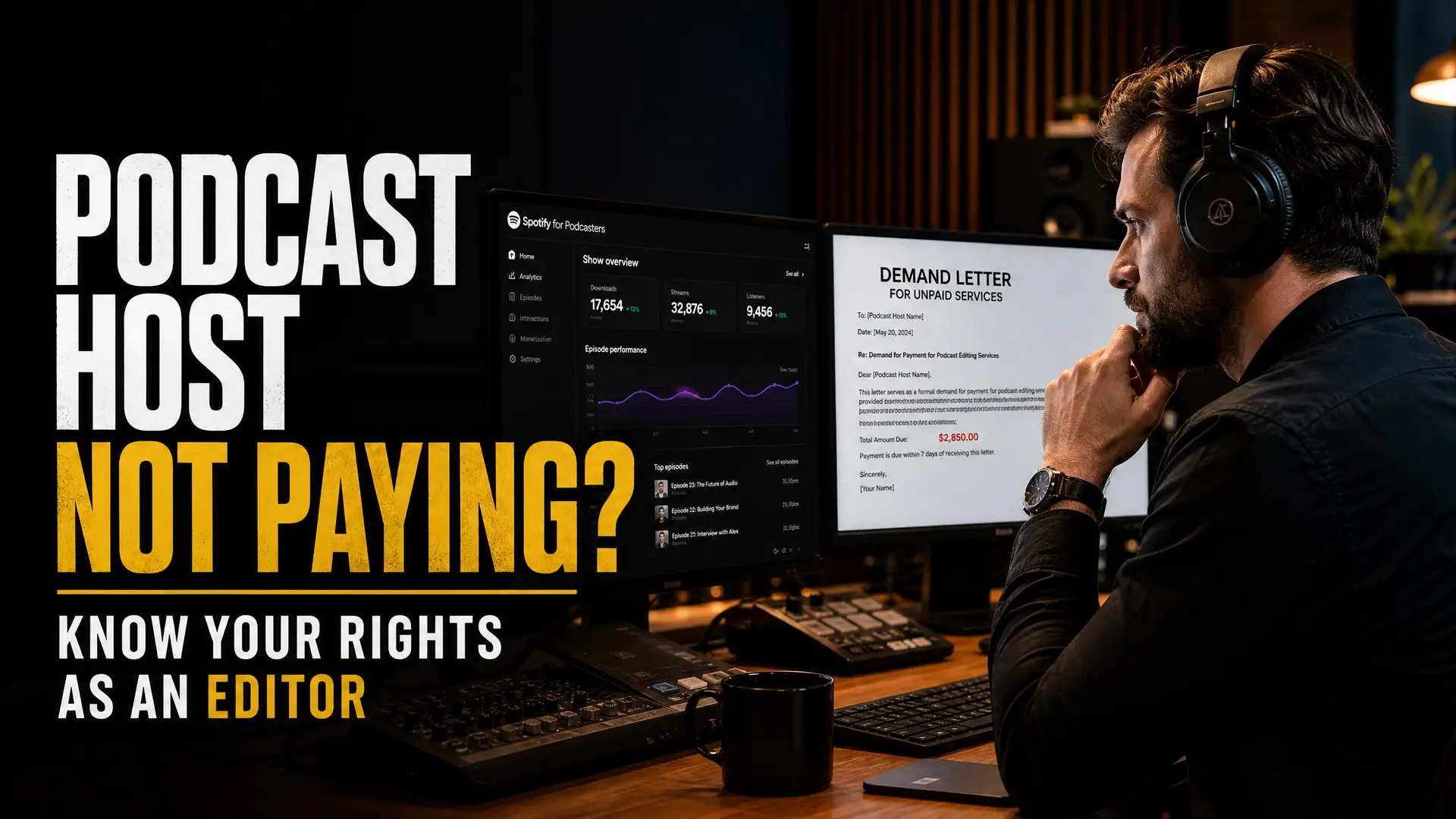
You probably think holding the login keys to a Spotify for Podcasters account makes you the boss. It does not.
I thought the same thing a few years ago. A client owed me for twelve fully edited episodes. I had the dashboard open. My finger actually hovered over the “delete” button.
I wanted to burn it all down. I was angry, tired, and felt completely disrespected.
But I didn’t click it. And I am going to tell you why you shouldn’t either.
Here is the direct answer, right up front.
In most commercial freelance arrangements, you should assume you do not have the legal right to delete a client’s published podcast episodes merely because an invoice remains unpaid.
The outcome ultimately depends on your contract, the governing law, and who owns the relevant intellectual property rights.
Deleting published content without contractual authority may expose you to claims such as unauthorized interference with property, breach of contract, copyright disputes, or business losses, depending on the applicable jurisdiction.
Hitting delete can quickly shift the legal focus away from the unpaid invoice and toward your own conduct, making recovery significantly more difficult.
Instead of deleting, you need to freeze their assets legally.
If you remain the copyright owner—or have not assigned your rights under the applicable agreement—you may have considerably stronger legal remedies than simply deleting files.
Let me walk you through exactly how the real creative business world handles this, step by step.
Table of Contents
The 90-Day Silent Podcast Host (A Real Case Study)
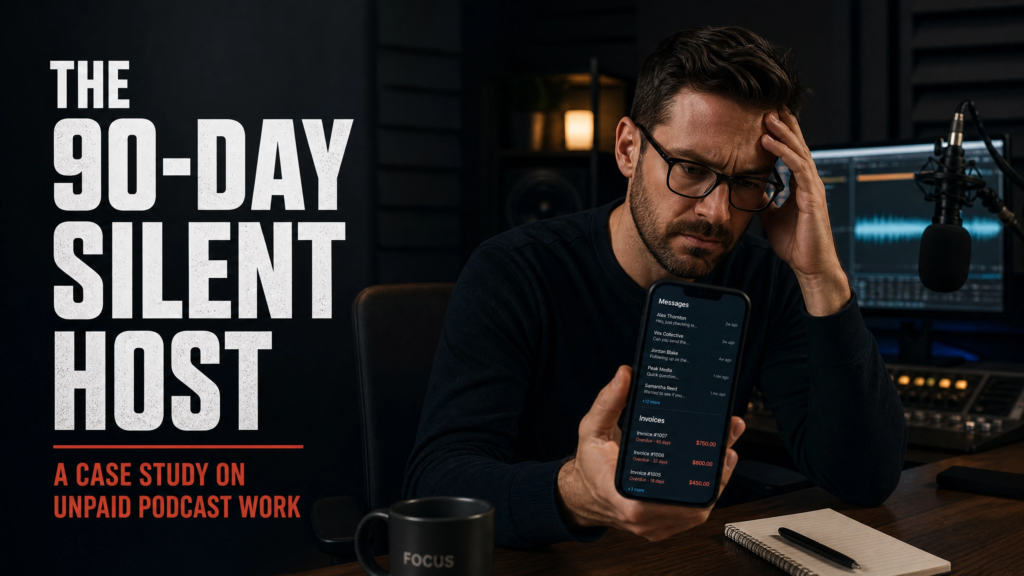
Let’s look at a scenario I see constantly. I call it the 90-Day Silent Host.
You started working with a charismatic entrepreneur. They wanted a slick, daily audio show. You agreed on a rate.
Month one went great. You edited the audio, mastered the EQ, wrote the show notes, and pushed it to the RSS feed.
Then month two hit. The invoice went ignored.
They kept sending raw files. You kept editing them, hoping the payment would clear.
Now it is month three. They owe you for 90 days of work. And they have completely stopped replying to your emails.
Look, My Client Ghosted Me After I Sent the Invoice—What Do I Do Now ? is the most common question I hear. It hurts.
You feel like a fool for continuing to work. You are watching their download numbers go up on the very dashboard you manage.
This is exactly what happened to a colleague of mine. Let’s call him Mark.
Mark edited a top-tier business podcast. The host ran out of funding but didn’t tell Mark.
If your Client runs out of money Mid-Project ? Legal & Smart Recovery Guide for Developers and editors applies here too.
Mark logged into Anchor (now Spotify for Podcasters) and deleted 15 episodes. He thought he was taking back his power.
Instead, the host’s lawyer sent Mark a massive demand letter.
The host claimed Mark destroyed sponsorship deliverables. The host threatened to sue Mark for lost advertising revenue.
Mark lost his leverage instantly. He was suddenly on the defensive.
RSS Feed Control vs. Creative Ownership
Here is the thing about podcasting. Having the password to the RSS feed does not mean you own the show.
You are a digital custodian. You are a mechanic who has the keys to a customer’s car.
If the customer refuses to pay for the oil change, the mechanic cannot legally set the car on fire.
This applies to digital assets too.
You might wonder What to Do When a Client Uses Your Work But Refuses to Pay You.
The secret lies in understanding copyright law, not server access.
Under the US Copyright Act of 1976 (17 U.S.C. § 201), the creator of a work owns the copyright the moment it is fixed in a tangible medium.
If your agreement does not transfer copyright ownership or qualify the work as a valid work made for hire, you may continue to own copyright in the portions of the work you created.
However, this depends on the governing law and the precise contractual language.
You do not own the host’s voice. You do not own their original raw recording.
But you own the derivative work—the polished, edited master file.
This is similar to when a Client used my video without paying. The final cut is your intellectual property until they pay for it.
In many commercial relationships, courts may recognize an implied license allowing the client to use the delivered work for its intended purpose. Whether such a license exists depends on the surrounding facts and contractual arrangements.
Deleting published content may create separate legal disputes that overshadow the original payment disagreement.
Instead of deleting content, consider obtaining legal advice on whether you are entitled to suspend, revoke, or challenge the client’s continued use of your work under your contract or applicable copyright law.
I know it sounds boring. But paper trails win disputes. Deleting files loses them.
The Protocol for Disabling Unpaid Audio Feeds
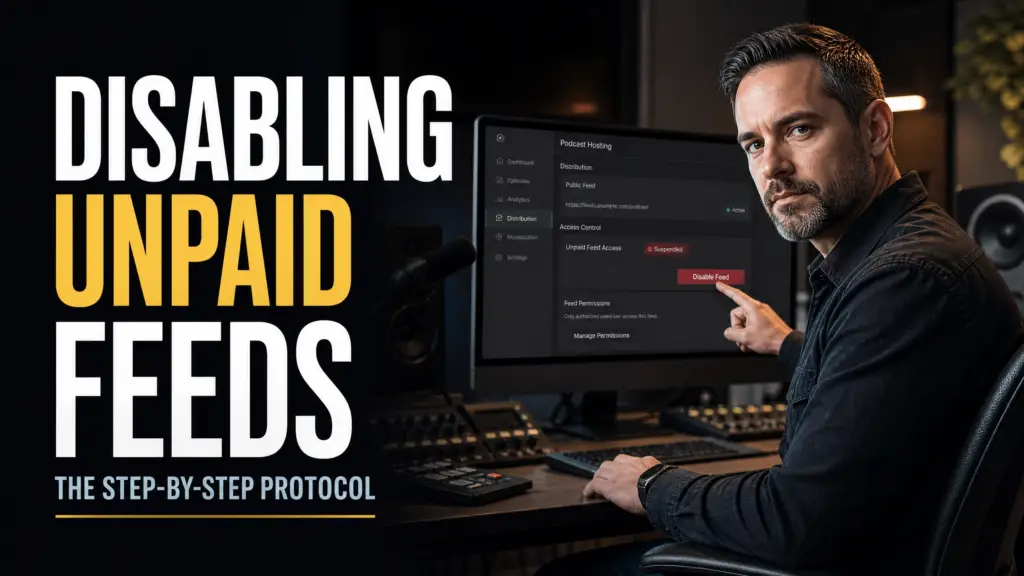
So, what do you actually do? You follow a strict protocol.
I rely heavily on practical risk management. You want your money, not a lawsuit.
Step 1 : Stop all current work immediately.
Do not edit another second of audio. Do not log into their dashboard to check stats.
You need to plug the leak first.
If they keep asking for small edits, read up on how to Stop Working for Free : How to Prevent Scope Creep From Eating Your Profits.
Step 2 : Send a formal revocation of license.
You inform them that because invoice #123 remains unpaid, their license to broadcast your edited masters is officially suspended.
This is much safer than hitting delete.
It is the exact same logic developers use. I often reference Can I Shut Down a Clients Server for Non-Payment ? ( Legal + Safe Method for Freelancers ) to show how delicate access revocation is.
You can also draw parallels to designers. Learning How to Revoke Access to Figma Files After Non-Payment (Safe & Legal Method) teaches you how to lock down assets without destroying them.
Step 3 : Unpublish, do not delete.
If you still have authorized access to their hosting platform, look for a “draft” or “unpublish” button.
Some platforms allow you to archive an episode. This pulls it from the RSS feed but keeps the file intact on the server.
This area is highly fact-specific and varies across jurisdictions, platform policies, and contractual arrangements.
If they claim you caused damages, you can easily say, “The files are safe. I simply paused public distribution pending payment.”
This shows intent to protect your IP, not malicious intent to destroy their business.
Freelancer Risk Matrix : Podcast Episode Actions
Here is a simple matrix I use to assess risk before taking any action.
| Action | Legal Risk to Editor | Effectiveness | Verdict |
| Deleting published episodes | HIGH | Low | Never do this. |
| Changing account passwords | HIGH | Medium | High risk of unauthorized access claims. |
| Unpublishing/Archiving episodes | MEDIUM | High | Safer, reversible, but still risky. |
| Sending a formal Cease & Desist | LOW | High | The professional standard. |
| Potential DMCA Notice (only where you genuinely own the copyright and the legal requirements are satisfied) | LOW | Very High | The nuclear, but legal, option. |
Contractual Recovery via Podcast Platform Terms
Let me be brutally honest. Spotify does not care about your unpaid invoice.
Spotify, Apple, and Amazon Music are distribution platforms. They host RSS feeds.
Their Terms of Service explicitly state they do not mediate contract disputes between hosts and producers.
Do not email Spotify support asking them to take down the show because you weren’t paid. They will ignore you.
However, they do respond to legally binding DMCA takedown notices.
If you remain the copyright owner and no assignment or work-for-hire arrangement transferred those rights, a properly supported DMCA notice may be available.
Non-payment alone does not automatically determine copyright ownership
Under the Digital Millennium Copyright Act, platforms must remove content if the legal copyright holder claims infringement.
But you must be 100% sure you actually hold the copyright.
If you negotiated via WhatsApp, you might be wondering, Can a WhatsApp Chat Count as a Legally Binding Contract? (US & UK Law).
The answer is often yes. Your text logs can prove they agreed to pay you for the rights to the audio.
This leads to the next logical question. When is it Officially Time for a Freelancer to Take Legal Action ?
From a commercial risk-management perspective, I generally treat 90 days of non-payment as the point where formal legal recovery should be seriously considered.
Structuring the Perfect Demand
You need to shift from being a passive victim to an active creditor.
Your invoice is a legal document.
If you struggle with getting paid on time, you need to learn How to Design an Invoice That Accounts Payable Teams Can’t Ignore.
It needs clear terms. It needs late fee warnings.
Speaking of late fees, Can You Legally Charge Interest on Late Invoices ? (US,UK, & India Rules) is a vital read.
Where legally permitted and contractually supported, charging interest reinforces the seriousness of the debt and may encourage earlier resolution.
I always tell freelancers to handle this themselves first.
You can learn How to Recover an Unpaid Invoice Yourself (Without Hiring a Lawyer). It takes patience and a cold, emotionless tone.
You need to remove your anger from the emails.
A calm, professional legal notice often carries considerably more weight than an emotional demand because it demonstrates preparation, credibility, and a willingness to enforce contractual rights.
When your communication is calm, well documented, and legally structured, it demonstrates credibility and often encourages more constructive negotiations.
US , UK vs Global Comparison : Digital Asset Rights
I deal with international clients constantly. The rules change depending on where you and the host live.
In the US, UK, and Australia
The concept of “Work Made for Hire” dominates US copyright philosophy, where independent contractors default to retaining their copyrights unless a specific written agreement states otherwise.
Under the U.S. Copyright Act (17 U.S.C. § 201), copyright ownership generally remains with the creator unless it is transferred through a valid written assignment, qualifying work-made-for-hire arrangement, or another legally recognized mechanism.
Whether non-payment affects ownership depends on the wording of the agreement.
The UK framework handles this through the Copyright, Designs and Patents Act 1988, which naturally favors the independent creator over the client unless an explicit, written transfer of intellectual property has occurred.
Similarly, in Australia, the Copyright Act 1968 (Cth) establishes that a freelance specialist owns the structural copyright of their produced media unless a corporate contract assigns it directly to the commissioning party.
In many freelance arrangements, an unpaid invoice may indicate that copyright ownership has not yet been transferred where the contract makes payment a condition of assignment.
However, the outcome depends on the governing agreement and applicable law.
In India and Globally
The framework changes slightly when dealing across borders or specifically within emerging legal markets like India.
Under Section 170 of the Indian Contract Act, 1872, there is a foundational concept called “Bailee’s Lien,” which allows an individual who performs skilled labor on physical goods to retain possession of those items until they are compensated.
However, trying to apply a physical lien to an intangible digital asset like a podcast MP3 is an uphill battle; once that audio file is handed over and uploaded to the hosting dashboard, your physical possession is completely severed.
Because the application of possessory lien principles to purely digital assets remains legally uncertain, freelancers generally rely on contractual remedies, copyright law, and civil recovery mechanisms instead.
Understanding these jurisdictional mechanics is crucial if your host lives overseas. To prevent these global standoffs from happening entirely, you must establish clear, strict terms up front.
Make sure to check out the Freelancer Payment Terms Guide : Avoid Net 60 & Late Payments – Freelance Recovery to bulletproof your cash flow on an international scale.
The Evidence Checklist
Before you make any moves, you need to gather your ammunition.
Do this quietly. Do this before you send any angry messages.
- The Original Agreement : Keep screenshots of emails, Upwork chats, or signed PDFs.
- The Unpaid Invoices : Export them as PDFs showing the exact overdue dates.
- Proof of Delivery : Keep logs of the Google Drive or Dropbox links where you sent the final masters.
- Platform Analytics (If available) : Take screenshots of the download numbers to prove they are actively benefiting from your unpaid labor.
- Communication Logs : Document every time you asked for payment and they ignored it or made an excuse.
Quick Decision Flowchart
Are you staring at your screen, wondering what to do right now ? Follow this path.
Is the invoice over 30 days late ?
- Yes: Stop new work. Send a firm reminder.
- No: Send a polite nudge. Do not panic yet.
Is the invoice over 60 days late ?
- Yes: Issue a formal Notice of Default. Add late fees if your contract allows it.
- No: Keep pushing for a payment date.
Is the invoice over 90 days late ?
- Yes: Revoke their license to use the audio. Draft a DMCA takedown or Final Legal Notice. Do NOT delete the files yourself.
Tool: Notice of Service Suspension Generator
I built a simple template you can use right now. Just copy this structure into your email client.
Keep it brief. Do not apologize.
Notice of Service Suspension Generator
Generate a cold, legally grounded license revocation and service pause notice for non-paying podcast clients.
Frequently Asked Questions
u003cstrongu003eCan I just change the Spotify for Podcasters password so they can’t log in ?u003c/strongu003e
No. Locking a client out of their own account can be framed as a cyber-security offense or tortious interference. It makes you look like the bad guy to a judge.
u003cstrongu003eWhat if I inserted an audio watermark in the episode ?u003c/strongu003e
If you did this before publishing, it is a brilliant strategy. Where appropriate and disclosed in advance, providing only watermarked previews until payment is received can significantly reduce the risk of unauthorized commercial use.
u003cstrongu003eDoes Spotify care if I prove I wasn’t paid ?u003c/strongu003e
No. Spotify is a neutral host. They will not intervene in a billing dispute. They only respond to formal legal takedowns (DMCA).
u003cstrongu003eCan I contact their sponsors directly to tell them the host doesn’t pay their team ?u003c/strongu003e
I strongly advise against this. This is called tortious interference with a business contract. The host could sue you for ruining their sponsorship deals, which costs way more than your unpaid invoice.
u003cstrongu003eShould I just cut my losses and walk away ?u003c/strongu003e
That is a personal choice. For $200, maybe. For $2,000, absolutely not. Fight for your money using paper trails and legal notices, not emotional sabotage.
Look, I know how frustrating it is to sit there and watch someone else build an audience off the back of your unpaid labor.
It makes you want to break things. It makes you want to hit delete.
But you are a professional business owner. Act like one.
Secure your evidence, revoke their license in writing, and let the legal framework do the heavy lifting. Keep your hands off the delete button.
About Author :
Adv. Sagar Haribhau Shirsat is an active legal professional specializing in commercial transaction architectures, cross-border corporate compliance, and digital debt recovery systems. He designs strategic asset-protection and recovery frameworks that help freelancers, independent contractors, and global agencies defend their cash flow and enforce their billing rights.
Connect via his Official Professional LinkedIn Profile.
Disclaimer : This guide is intended for educational purposes and risk management analysis. It does not replace formal legal counsel. For specific cross-jurisdictional contract disputes, always consult a certified attorney or local legal advocate.
Because copyright ownership, contract interpretation, platform policies, and available remedies vary significantly across jurisdictions, readers should obtain legal advice specific to their own circumstances before taking action against a client or modifying access to published content.