I used to believe the CEO was the final boss.
When I started freelancing, I thought that if a founder ignored my invoice, my only options were to keep sending follow-ups, wait patiently, or immediately hire a lawyer.
I was wrong.
The real issue is that freelancers often communicate with the wrong person for too long.
If the person responsible for approving payment has stopped responding, continuing to send the same email to that person may not create any new pressure. In some companies, the next appropriate escalation point may be the finance department, accounts-payable team, CFO, general counsel, or—where the company actually has a relevant governance structure—a board member.
That does not mean a board member is personally responsible for your invoice.
It does not mean a board member must order the company to pay you.
And it certainly does not mean that copying an investor guarantees payment.
But a factual, professional escalation can sometimes cause an unresolved payable to receive internal attention that routine follow-ups did not.
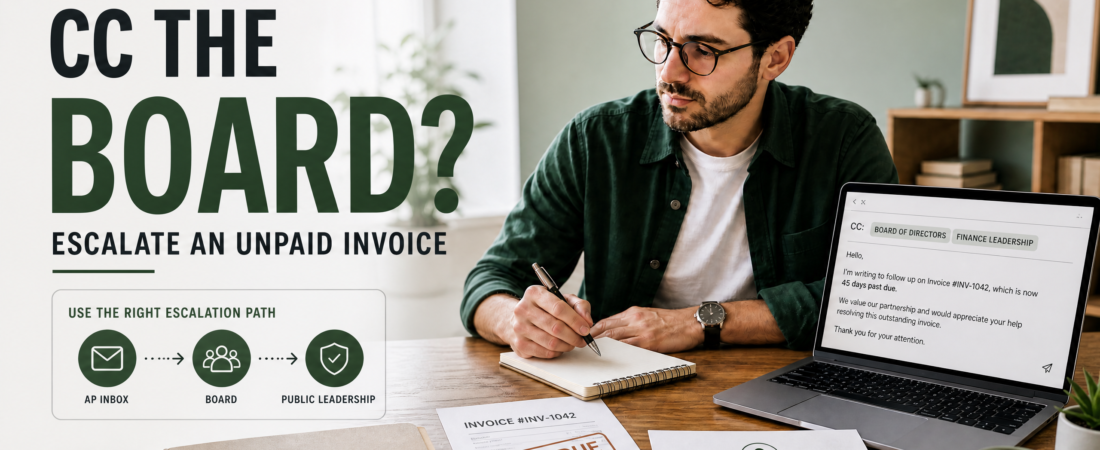
That is the real idea behind what I call the “CC Your Board” technique.
It is not about threatening the founder.
It is about making sure a legitimate unresolved vendor balance reaches an appropriate level of the company’s organization when ordinary payment channels have failed.
If you are already dealing with a late invoice, start by reviewing the exact follow-up timeline for late freelance invoices before escalating.
The Case Study: The $18,000 Ghosting
Let me tell you about a mistake I made three years ago.
I took on a complex technology migration for a well-funded logistics startup. The project went according to the agreed milestones. The deliverables were completed, and I submitted my final invoice for $18,000.
Then the communication stopped.
For several weeks, I received no meaningful payment update.
It was frustrating because I could see the founder publicly discussing the company’s growth while my invoice remained unresolved. It reminded me of the familiar situation where a client ignores your Slack messages but continues posting on LinkedIn.
I initially considered hiring a lawyer.
But before spending money on formal legal action, I reviewed the contract, the invoice, my delivery records and the communication history.
The underlying problem was not that I lacked evidence.
The problem was that the person I had been contacting was simply not moving the payment process forward.
The Breakdown
I had already made multiple ordinary attempts to resolve the account.
I did not want to send an unnecessarily hostile legal threat. At the same time, continuing to send identical reminders was unlikely to change the situation.
So I researched the company’s governance structure.
I identified an investor who was publicly identified as having a governance relationship with the company. I did not assume that being the lead investor automatically meant that person was a director. I verified the individual’s role before considering an escalation.
I then prepared a short, factual email.
The subject was:
Account Status Update — Unresolved Vendor Payable
The message did not accuse the founder of fraud.
It did not threaten criminal consequences.
It did not claim that the board member was personally liable.
It simply documented the outstanding invoice and asked for a payment timeline.
The Result
The founder had been unresponsive for approximately 32 days.
After the governance-level escalation, I received a call within minutes. The founder explained that there had apparently been an internal accounting problem.
The invoice was paid shortly afterward.
That result was useful, but there is an important lesson here:
My experience is an anecdote, not proof that copying a board member will produce the same result for everyone.
Sometimes it will get attention.
Sometimes the board member will forward the message to management.
Sometimes the message will be ignored.
Sometimes it may damage the commercial relationship.
The technique therefore should be treated as an escalation option, not a guaranteed payment mechanism.
1. The Founder May Not Be the Only Person Who Can Resolve the Problem

One of the biggest mistakes freelancers make is treating the founder as the entire company.
A startup may have:
- a founder or CEO;
- a controller or CFO;
- an accounts-payable team;
- an operations manager;
- general counsel;
- outside counsel;
- a board of directors;
- investor-appointed directors;
- independent directors;
- or no formal board at all.
The correct escalation point depends on the company’s actual structure.
For example, a routine invoice problem may be better handled by accounts payable than by the board.
If the client repeatedly claims that the invoice disappeared inside accounting, first read what to do when a corporate client claims your invoice was lost in accounting and how to get paid by corporate accounts payable when the client says the invoice was lost.
The board should generally be considered a higher-level escalation, not the first stop.
2. What the Board Actually Does—and What It Does Not Do
This is where freelancers need to be careful.
A corporate board is not simply a collection of investors who can personally order a company to pay every vendor.
In Delaware corporations, for example, the statute provides that the business and affairs of the corporation are managed by or under the direction of the board, subject to the corporation’s governing documents and applicable law.
You can review the official Delaware General Corporation Law provisions concerning boards of directors.
But that does not mean every investor is a director.
It also does not mean every director is responsible for an individual contractor invoice.
And it does not automatically create personal liability for a board member simply because the company owes money.
The distinction matters.
Investor ≠ Director
A venture-capital firm may invest in a company without holding a board seat.
An individual partner may be associated with an investment without being a director.
A board observer may have information rights without having the same legal status as a director.
Therefore:
Do not assume that the lead investor is a board member. Verify the actual role.
Director ≠ Personal Guarantor
Even where an individual is a director, that does not automatically make that person personally responsible for the corporation’s ordinary commercial debts.
Your claim is generally against the contracting entity, subject to the contract, applicable law and available remedies.
That is why this strategy should be framed as internal escalation, not personal debt collection against the director.
3. Why Governance-Level Escalation Can Sometimes Get Attention
There is a legitimate business reason to escalate an unresolved payable.
Boards are involved in oversight and corporate decision-making, while executives generally handle day-to-day operations.
The precise responsibilities vary by jurisdiction and company structure.
The Cornell Legal Information Institute’s explanation of fiduciary duty notes that corporate directors can owe fiduciary duties, while its discussion of the duty of care explains that these duties generally run to the corporation rather than automatically to every individual creditor or vendor.
That distinction is critical.
You are not writing:
“You are personally liable for my invoice.”
You are writing:
“There is an unresolved company payable, and I am asking for the appropriate internal team to confirm the payment status.”
That is a much more defensible position.
A board member may decide to ask management:
- Is this invoice legitimate?
- Was the work accepted?
- Is there a contractual dispute?
- Has the invoice been entered into accounts payable?
- Why is a vendor saying payment has not been made?
- Is there an administrative problem?
- Does finance need to resolve the issue?
The board may do nothing.
But the issue has now reached a different level of the organization.
That is the leverage.
4. How to Verify the Company’s Governance Structure
Do not guess.
Do not simply find the most famous investor in the company’s funding history and assume that person sits on the board.
Use a verification process.
Step 1: Identify the Legal Entity
First confirm the company’s actual legal name.
The brand name on its website may not be the entity named in your contract.
Check:
- your signed agreement;
- invoice;
- purchase order;
- corporate website;
- applicable corporate registry;
- public filings where available.
This becomes especially important if you are considering legal action later.
If you have no formal written contract, review Can You Sue a Client Without a Contract? before making assumptions about your rights.
Step 2: Identify the Actual Governance Structure
Look for reliable evidence of:
- directors;
- board members;
- board observers;
- officers;
- parent companies;
- subsidiaries;
- investors.
Use company announcements, regulatory filings and appropriate corporate records where available.
Investor databases and LinkedIn can help with discovery, but do not treat them as conclusive proof of a person’s legal role.
Step 3: Verify the Individual
If you believe a particular investor is a director, verify that relationship through a reliable source.
Do not write:
“I know you are on the board.”
unless you actually know that.
Write:
“I understand that you serve as a director of [Company]…”
only when you have a reasonable basis for saying so.
Step 4: Use an Appropriate Professional Contact
Use a publicly available professional business address or official corporate channel where appropriate.
Do not guess personal email addresses.
Do not use private contact information obtained through questionable means.
The goal is legitimate business communication—not bypassing someone’s privacy controls.
5. When Should You Actually Consider This Escalation?
This is where the technique becomes useful.
I would generally consider governance-level escalation only when several conditions are present.
Condition 1: The invoice is genuinely due
Check:
- contract;
- payment terms;
- acceptance requirements;
- milestone conditions;
- applicable taxes;
- disputed amounts.
If the client has raised a legitimate contractual dispute, copying the board may not solve the underlying problem.
If your payment terms are weak, first review the Freelancer Payment Terms Guide.
You can also compare your terms with Net 15 vs. Net 30 vs. Net 45 payment terms.
Condition 2: You have already tried ordinary channels
A governance escalation should not normally be your Day 2 email.
You should usually have attempted reasonable communication through:
- the founder;
- project contact;
- accounts payable;
- finance;
- or another designated payment contact.
For a structured reminder sequence, see Unpaid Invoice Follow-Up Email Templates.
Condition 3: The company has failed to provide a meaningful resolution
There is a difference between:
“We received your invoice and will pay Friday.”
and:
complete silence for weeks.
If the client is communicating and genuinely working through an accounting issue, escalation may be unnecessary.
Condition 4: You can prove the debt
Before escalating, make sure you can produce:
- the agreement;
- invoice;
- delivery evidence;
- acceptance evidence;
- correspondence;
- payment history;
- previous reminders.
If your communication history is important, consider creating a legally defensible invoice statement from your email trail.
Condition 5: You understand the commercial consequence
Copying a board member can permanently change the relationship.
If preserving the client relationship is more valuable than accelerating collection, negotiate first.
If the relationship is already effectively broken, the calculation may be different.
6. The Professional Notice of Unresolved Balance
This is the most important part.
Do not write:
“Your CEO is stealing my money.”
Do not write:
“I will expose your company to your investors.”
Do not write:
“Your directors will be personally liable.”
Do not make allegations you cannot prove.
Instead, use a neutral administrative notice.
Suggested Structure
Subject: Account Status Update — Unresolved Vendor Payable
Dear [Founder/Finance Contact],
I am writing regarding Invoice #[Number], dated [Date], in the amount of [Amount], which is currently [Number] days past the contractual due date.
I have previously contacted [Name/Team] on [Dates] regarding the outstanding balance, but the account remains unresolved.
I am copying [Name/Board Member/Finance Contact] so that the appropriate internal team has visibility of the outstanding vendor account and can confirm the current payment status.
Please confirm the expected payment date by [Date].
I am happy to provide the contract, invoice, delivery records and prior correspondence if required.
Regards,
[Your Name]
Notice what this email does not do.
It does not threaten.
It does not accuse.
It does not exaggerate.
It does not claim that the board member is personally liable.
It simply creates visibility.
That is the point.
7. Why “Compliance” Language Should Be Used Carefully
The original version of this strategy used phrases such as:
“governance priority”
and
“compliance update.”
Those phrases can sound impressive, but they should not be used merely to intimidate someone.
If you are not actually reporting a regulatory violation, don’t manufacture one.
Use factual language such as:
- outstanding vendor balance;
- overdue invoice;
- unresolved payable;
- payment status;
- contractual payment obligation;
- supporting documentation;
- accounts-payable review.
Those phrases are boring.
Boring is good.
Your objective is to create a clean record, not to make the email look like a regulatory enforcement notice.
8. The Email Generator
If you have already built a functioning interactive generator on the page, this is an excellent place to use it.
The tool should help freelancers generate a factual escalation notice rather than a threatening demand.
<!-- Board-Level Notice Generator UI -->
<div style="font-family: Arial, sans-serif; border: 1px solid #ccc; padding: 20px; border-radius: 8px; max-width: 600px; background-color: #f9f9f9;">
  <h3 style="color: #333; margin-top: 0;">Notice of Unresolved Balance Generator</h3>

  <label style="font-weight: bold; font-size: 14px;">To:</label>
  <input type="text" value="[Founder / Finance Contact Email]" style="width: 100%; padding: 8px; margin-bottom: 10px; border: 1px solid #ddd; border-radius: 4px;">

  <label style="font-weight: bold; font-size: 14px;">CC:</label>
  <input type="text" value="[Verified Board / Governance / Finance Contact]" style="width: 100%; padding: 8px; margin-bottom: 10px; border: 1px solid #ddd; border-radius: 4px;">

  <label style="font-weight: bold; font-size: 14px;">Subject:</label>
  <input type="text" value="Account Status Update — Unresolved Vendor Payable" style="width: 100%; padding: 8px; margin-bottom: 15px; border: 1px solid #ddd; border-radius: 4px;">

  <label style="font-weight: bold; font-size: 14px;">Message Body:</label>
  <textarea style="width: 100%; height: 250px; padding: 10px; border: 1px solid #ddd; border-radius: 4px; font-family: monospace;">
Dear [Name],

I am writing regarding Invoice #[Number], dated [Date], in the amount of [Amount], which is currently [Number] days past the contractual due date.

I have previously contacted [Name/Team] on [Dates] regarding the outstanding balance, but the account remains unresolved.

I am copying [Name] so that the appropriate internal team has visibility of the outstanding vendor account and can confirm the current payment status.

Please confirm the expected payment date by [Date].

I am happy to provide the contract, invoice, delivery records and prior correspondence if required.

Regards,
[Your Name]
  </textarea>
</div>
The goal of this generator should be documentation and escalation, not intimidation.
9. The Legal Mechanics: Do Not Confuse Governance With Personal Liability
This distinction deserves its own section because freelancers frequently misunderstand it.
A corporation is generally a separate legal entity from its directors and shareholders.
An unpaid corporate invoice does not automatically become the personal debt of a director.
Likewise, a director’s fiduciary duties generally concern the corporation and its governance responsibilities rather than creating a direct contractual obligation to every unpaid vendor.
The Cornell Legal Information Institute’s explanation of the duty of care specifically explains that corporate fiduciary duties generally run to the corporation rather than automatically to every stakeholder.
This means your escalation email should focus on:
“The company owes this amount under the agreement.”
Not:
“You personally owe me this amount because you are a director.”
Those are completely different propositions.
10. USA, UK and India: Governance Rules Are Not Identical
Corporate governance is jurisdiction-specific.
Do not take a Delaware rule and automatically apply it to an Indian private company.
Do not take a UK director duty and assume it produces the same creditor remedies in the United States.
For example, UK Companies Act 2006 section 172 requires directors to act in good faith in a way they consider most likely to promote the company’s success for the benefit of its members as a whole, while also requiring consideration of matters including business relationships with suppliers and others. The provision also expressly recognizes circumstances in which directors may have to consider creditors’ interests under other law.
You can read the UK Companies Act 2006 provisions on directors’ general duties.
In India, section 166 of the Companies Act, 2013 sets out statutory duties of directors, including acting in accordance with the company’s articles and specified duties concerning good faith and the interests of the company.
You can review the official Companies Act, 2013 text from India’s Ministry of Corporate Affairs.
The practical lesson is simple:
Use governance escalation to create visibility. Do not use a broad statement about “fiduciary duty” as a substitute for jurisdiction-specific legal analysis.
11. What About Debt-Collection Laws?
Another important distinction:
An unpaid business-to-business invoice is not necessarily governed by the same laws as a consumer debt.
For example, the U.S. Fair Debt Collection Practices Act contains restrictions on harassment, false or misleading representations and certain collection practices, but its federal protections are principally directed at consumer debts and debt collectors within its scope.
The Federal Trade Commission’s debt-collection guidance is useful background, but freelancers should not assume that every B2B invoice dispute automatically falls under the FDCPA.
The broader professional lesson still matters:
Never make false statements, fake legal threats or claims of personal liability that you cannot substantiate.
That is good practice regardless of which collection statute applies.
12. The Evidence Checklist
Before escalating to a board member, organize your evidence.
You should ideally have:
1. The Executed Contract
Confirm:
- parties;
- scope;
- payment terms;
- acceptance provisions;
- governing law;
- dispute-resolution clause.
If you are still designing your contracts, see How to Structure a Proposal So It Functions Like a Real Legal Defense Contract.
2. Proof of Delivery
Keep:
- project files;
- repository records;
- delivery emails;
- acceptance messages;
- milestone approvals;
- timestamps.
3. The Original Invoice
The invoice should clearly identify:
- legal entity;
- invoice number;
- amount;
- due date;
- payment instructions.
For better invoice design, see How to Design an Invoice That Accounts Payable Teams Can’t Ignore.
4. Communication History
Save the relevant emails, Slack messages and other communications.
Do not send 200 pages of irrelevant correspondence.
Create a concise chronology.
5. Previous Payment Requests
Show that you attempted reasonable resolution before escalating.
6. The Final Notice
If appropriate, preserve the final notice before legal action and evidence of delivery.
13. What If the Client Says the Work Is Defective?
This is where you need to slow down.
Do not escalate simply because an invoice is unpaid.
First determine why it is unpaid.
If the client says:
“We never received the deliverables.”
that is different from:
“We received everything but accounting hasn’t processed the invoice.”
If the client alleges:
- defects;
- incomplete work;
- scope disputes;
- unauthorized expenses;
- missed milestones;
- breach of contract;
you need to address the underlying dispute.
For example, if the client suddenly claims the entire project changed after delivery, review the Kill Fee Strategy for a Client Who Changed the Entire Project.
If the client demands additional work that was never contracted, see how to charge for scope creep without losing the client.
If the client claims the final amount is disputed because of a third-party problem, review what to do when a client refuses the final amount because of a third-party API failure.
The board should not become your shortcut around a legitimate contractual dispute.
14. The Risk Matrix
Every escalation carries risk.
Low Risk: Routine Finance Escalation
If the company has a clearly identified accounts-payable or finance contact, moving the invoice there is usually much less confrontational than contacting the board.
Use this first when appropriate.
Medium Risk: Executive Escalation
Escalating from a project manager to:
- CFO;
- COO;
- finance director;
- general counsel;
can increase visibility without immediately turning the matter into a governance dispute.
Higher Risk: Board-Level Escalation
Copying an actual director or governance contact can permanently alter the relationship.
The founder may regard the escalation as a serious loss of trust.
That does not necessarily make it wrong.
But you should make the decision consciously.
Very High Risk: Public Pressure
Do not confuse private governance escalation with public exposure.
Posting accusations about a company or founder on social media is an entirely different risk category.
Your objective should be to recover a legitimate debt, not create a public dispute.
15. Do Not Use This Technique on Day Two
This is one of the most important rules.
If the invoice is two days late and the client is communicating with you, do not start copying investors.
That makes you look impatient rather than professional.
A better sequence is:
Day 0: Invoice becomes due.
Days 1–7: Professional reminder.
Following period: Confirm receipt and accounts-payable status.
Escalation: Contact finance or the responsible executive if necessary.
Final notice: State the balance, contractual basis, deadline and intended next step.
Governance escalation: Consider only when ordinary channels have failed and the circumstances justify it.
Formal legal remedy: Consider when the amount, evidence and jurisdiction make legal action commercially sensible.
For guidance on deciding when escalation should become formal legal action, see When Is It Officially Time for a Freelancer to Take Legal Action?.
16. Quick Decision Section: Should You CC the Board?
Use this checklist.
Question 1: Is the invoice actually due?
No: Fix the contractual or billing issue first.
Yes: Continue.
Question 2: Is there a genuine unresolved dispute?
Yes: Address the dispute before escalating.
No: Continue.
Question 3: Have you already contacted the appropriate payment channels?
No: Do that first.
Yes: Continue.
Question 4: Have you given the client a reasonable opportunity to resolve the balance?
No: Send a professional final request.
Yes: Continue.
Question 5: Can you prove the amount and contractual basis?
No: Build your evidence file first.
Yes: Continue.
Question 6: Is there an identifiable governance contact?
No: Do not invent one.
Yes: Continue.
Question 7: Are you prepared for the commercial relationship to deteriorate?
No: Negotiate first.
Yes: A governance-level escalation may be reasonable.
17. Dealing With the Fallout
Let’s say you send the email.
What happens next?
There is no universal script.
The board member may:
- ignore the email;
- forward it to management;
- forward it to finance;
- ask for supporting documentation;
- ask the founder to explain the account;
- ask counsel or finance to review the matter;
- or simply take no action.
Do not assume that silence means the board member is “scared.”
You don’t know what is happening internally.
The founder may also respond defensively.
They might write:
“I am disappointed that you escalated this to our investors.”
Do not get dragged into an emotional argument.
A professional response is:
“Thank you for the update. Please confirm the expected payment date and provide the remittance confirmation once the transfer has been initiated.”
That keeps the conversation focused on the actual objective.
18. What If the Founder Says the Invoice Is Being Processed?
Great.
Stop escalating.
If the founder gives you a specific payment date and the date is reasonable, document it and wait.
Do not keep increasing pressure simply because you now have access to a board member.
The goal is payment, not maximum pressure.
19. What If the Client Offers a Small Partial Payment?
Be careful.
A partial payment can be useful, but accepting money does not automatically resolve the remaining balance.
Depending on the jurisdiction and circumstances, accepting or documenting a partial payment can have legal consequences for how the remaining balance is characterized.
Before accepting a settlement-like partial payment, review the circumstances carefully. Our guide on the partial-payment trap explains why freelancers should not casually treat a small payment as a full resolution.
If you agree to a reduced settlement, put the settlement terms in writing.
20. What If the Company Is Running Out of Money?
This is a different situation.
If the client has stopped paying vendors because the company is experiencing serious financial problems, copying the board may not magically create cash.
You may need to determine:
- whether the company is still operating;
- whether an insolvency or bankruptcy process has begun;
- whether you need to file a claim;
- whether there are contractual security rights;
- whether a personal guarantee exists;
- whether another legal remedy is available.
If the corporate client is showing signs of financial distress, read What Happens to Your Invoice If Your Corporate Client Goes Bankrupt?.
If you are working on a project and the client runs out of money halfway through, see Client Runs Out of Money Mid-Project: Legal & Smart Recovery Guide for Developers.
21. Advanced Tactic: Escalate to the Right Executive Instead
Not every company needs a board escalation.
In many cases, the better person may be:
- CFO;
- controller;
- head of finance;
- general counsel;
- procurement director;
- accounts-payable manager.
This can be particularly effective where the company has a formal finance department but the founder is simply not responding.
Remember:
The closer your escalation point is to the actual payment process, the less dramatic the escalation usually needs to be.
A CFO who can approve a payment may be far more useful than an investor who owns a minority stake but has no operational role.
22. What If There Is No Board?
Many small businesses do not have the governance structure you are imagining.
A sole proprietor has no board of directors.
A small founder-owned business may have no external investors.
A partnership may operate under a completely different governance structure.
In those cases, use the actual escalation path available.
That may include:
- owner;
- managing partner;
- finance manager;
- registered office;
- formal demand;
- mediation;
- arbitration;
- small claims;
- civil proceedings;
- collection agency.
If you want to attempt recovery without immediately hiring counsel, see How to Recover an Unpaid Invoice Yourself Without Hiring a Lawyer.
23. What If the Client Has Your Work but Still Hasn’t Paid?
Do not automatically assume that withholding access, deleting files or shutting down infrastructure is lawful.
Your contractual rights matter.
For example, if a client has your code on AWS, see The Code-Audit Breakdown for an Unpaid AWS Project.
If you are considering shutting down a client’s server, read Can I Shut Down a Client’s Server for Non-Payment? before taking action.
If the dispute concerns Figma deliverables, see How to Revoke Access to Figma Files After Non-Payment.
The same principle applies here:
Do not turn a payment dispute into a separate breach-of-contract, data-access, copyright or security dispute.
24. When the “CC Your Board” Technique Is a Bad Idea
Do not use this approach simply because you are angry.
Avoid it where:
- the invoice is genuinely disputed;
- the work is incomplete;
- the client has a legitimate defect claim;
- you have not followed the agreed dispute process;
- you cannot prove the debt;
- you are relying on an unverified assumption about someone’s board position;
- you intend to make public accusations;
- you are threatening consequences you cannot lawfully pursue;
- your only goal is to embarrass the founder.
The strongest escalation is usually the one that looks least emotional.
25. FAQs
1. Is it illegal to CC a board member on an unpaid invoice?
There is no universal rule making the act of copying a board member on a legitimate business communication illegal. However, legality depends on the circumstances, jurisdiction, contractual obligations and what the communication says.
The safer approach is to state only accurate facts, avoid threats and avoid disclosing information to people who have no legitimate business reason to receive it.
2. Does a board member become personally liable for my unpaid invoice?
Generally, you should not assume that.
A corporation’s debt is not automatically the personal debt of its directors or investors.
Personal liability can depend on separate facts such as guarantees, statutory provisions, misconduct, veil-piercing doctrines and jurisdiction-specific law.
Do not use a board escalation email to assert personal liability unless you have a specific legal basis.
3. Does the lead investor automatically sit on the board?
No.
A lead investor may have a board seat, board-observer rights, information rights or no governance role at all.
Verify the person’s actual position.
4. Should I warn the founder before escalating?
Usually, yes, when practical.
A clean final notice might say:
“If the outstanding balance remains unresolved by [date], I will escalate the matter through the appropriate finance and governance channels.”
Do not make a threat you do not intend to carry out.
5. What if the founder says the board escalation was inappropriate?
Stay calm.
You can respond:
“I understand that you would have preferred the matter to remain at the operational level. I escalated because the account had remained unresolved despite previous attempts to obtain a payment status. My objective remains simply to resolve the outstanding invoice.”
Then return to the payment question.
6. What if the board member asks for evidence?
That is actually a good development.
Send a concise evidence package:
- contract;
- invoice;
- delivery/acceptance evidence;
- payment terms;
- communication chronology;
- final notice.
Do not send an enormous unorganized document dump.
7. What if the board member forwards everything back to the founder?
That can happen.
Do not interpret it as failure.
You have still created a documented escalation and given the company an opportunity to resolve the account.
If payment remains outstanding, consider the next contractual or legal remedy.
8. What if the company is insolvent?
A board escalation may have limited practical value if the company simply lacks funds.
At that point, your rights may depend on insolvency law, creditor priority, bankruptcy proceedings and the jurisdiction involved.
Do not assume that an unpaid invoice gives you priority over secured creditors or other claimants.
9. Can I threaten to contact investors?
Be careful with wording.
There is a major difference between:
“If this remains unresolved, I will provide the appropriate internal governance contact with a factual account of the outstanding invoice.”
and:
“Pay me or I will destroy your relationship with your investors.”
The first describes a potential business escalation.
The second can create unnecessary legal and reputational risk.
10. Is this better than hiring a lawyer?
Not necessarily.
For a modest invoice, a professional escalation may be commercially sensible.
For a large dispute, contested contract, cross-border matter, insolvency situation or serious legal issue, professional legal advice may be appropriate.
The correct question is not:
“Can I avoid lawyers forever?”
It is:
“What escalation produces the best expected recovery after accounting for cost, time and legal risk?”
The 5-Point Board Escalation Rule
Before you press Send, check these five boxes:
1. The money is actually due.
2. You have documentary evidence.
3. You have already attempted reasonable internal resolution.
4. The person you’re contacting actually has a legitimate governance or finance connection to the company.
5. Your message is factual, proportionate and free of threats you cannot lawfully or realistically carry out.
If all five are true, governance-level escalation may be worth considering.
If even two or three are missing, slow down.
Final Thoughts: Escalation Is Leverage, Not a Weapon
Freelancing is a business.
You are not required to spend months sending increasingly desperate reminders to someone who refuses to give you a meaningful payment status.
But there is an important difference between professional escalation and pressure for pressure’s sake.
The strongest freelancer does not need to sound angry.
They have:
- a signed agreement;
- a valid invoice;
- documented delivery;
- a clean communication history;
- a clear payment deadline;
- and a proportionate escalation plan.
Sometimes that plan ends with accounts payable.
Sometimes it ends with a CFO.
Sometimes it ends with a formal demand.
And in the right circumstances, it may include a factual notification to an appropriate board or governance contact.
But the board is not your personal collection agency.
A director is not automatically your debtor.
An investor is not automatically a board member.
And copying someone senior does not guarantee payment.
The real advantage is visibility.
When an unresolved corporate payable has already passed through reasonable operational channels, making the right person aware of the problem can create an additional opportunity for the company to resolve it.
That is the professional version of the “CC Your Board” technique.
Be factual. Be documented. Be proportionate. And escalate because you have a legitimate business reason—not because you want to embarrass someone.
Author Box
Adv. Sagar Haribhau Shirsat is an Indian advocate writing about freelance contracts, unpaid invoices, commercial disputes, payment-recovery strategies, and practical legal risk management for independent professionals, contractors, and agencies.
His work focuses on turning messy freelance payment disputes into organized evidence, documented escalation and commercially sensible recovery decisions.
Disclaimer: This article is provided for educational and general informational purposes only. It is not a substitute for legal advice concerning a particular dispute. Corporate governance, director duties, debt-collection rules, contract remedies and creditor rights vary substantially by jurisdiction and by the facts of the matter. Before taking action against a client, investor, director or company, obtain advice from a qualified lawyer or advocate in the relevant jurisdiction where appropriate.
Last reviewed: September 9, 2026