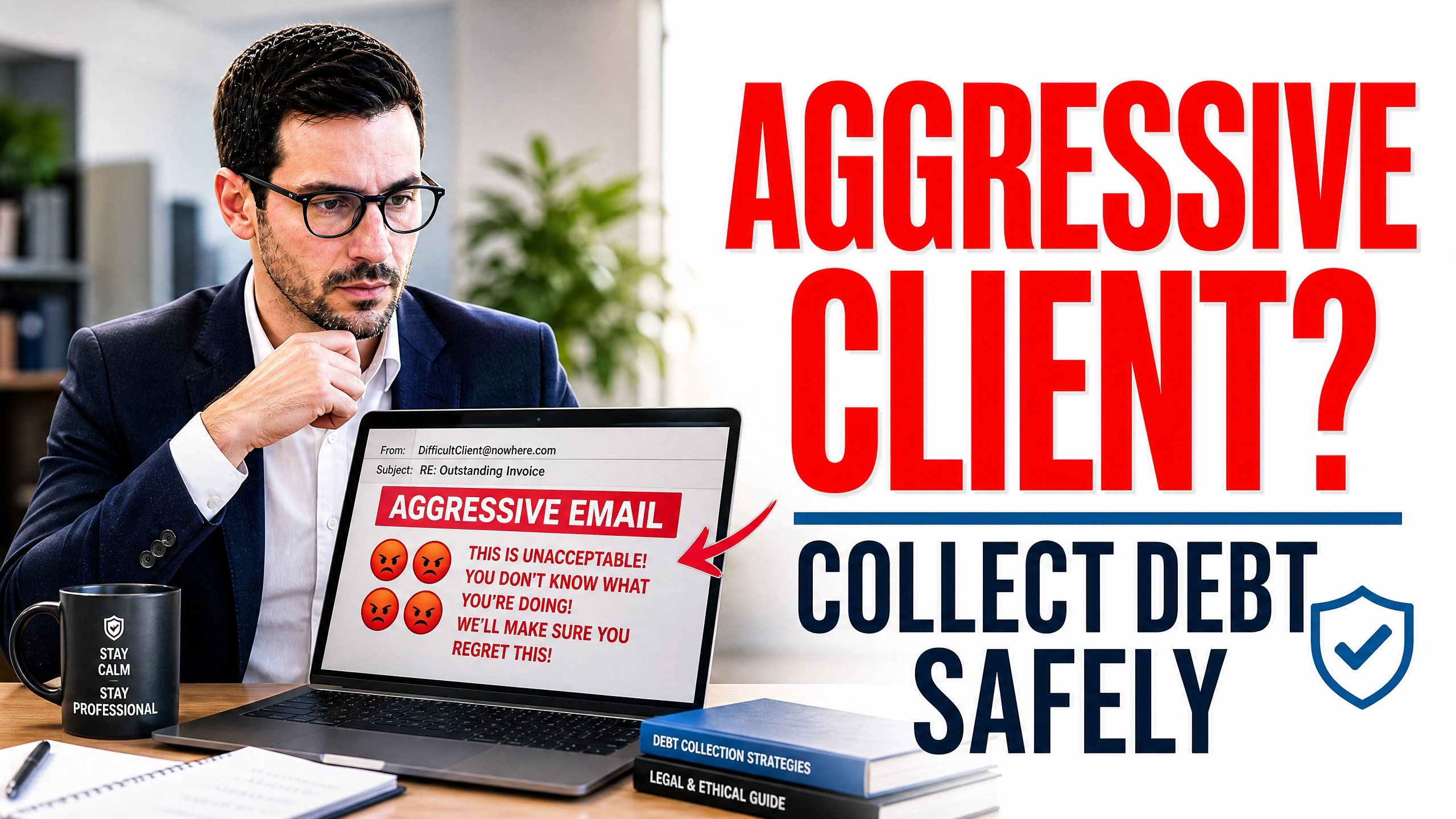
I still remember staring at my laptop screen at 2:14 AM. The email staring back at me was written entirely in capital letters.
The client wasn’t just refusing to pay my $4,500 invoice. He was threatening to ruin my reputation, sue me for damages, and ensure I “never worked in this industry again.”
My chest felt tight. My heart was pounding. I desperately wanted to fire back an angry, defensive email.
I didn’t. And that decision saved my business.
Look, I’m not a boardroom lawyer in a suit. I’m a freelancer, just like you. I’ve made every mistake in the book.
I used to argue with clients. I used to let them dictate my emotional state. But over the years, I learned something crucial about the creative business world.
Aggression is almost always a mask for leverage. They want you to panic. They want you to walk away from your money.
If you are wondering how to safely collect debt from a client who is intimidating or aggressive over email, you are in the right place.
We are going to neutralize the emotion. We are going to build an immaculate paper trail. Let’s get your money safely.
Table of Contents
The Bully Client Anatomy (Why They Attack)

Before you can defend yourself, you need to understand what you are looking at.
When a client attacks you over email regarding a late payment, it rarely has anything to do with the quality of your work.
Here’s the truth: they are usually deflecting. They might be out of money. They might be trying to squeeze you for free revisions.
Sometimes, they are just relying on the fact that freelancers usually cave under pressure.
I call this the “smoke and mirrors” defense. They create a massive emotional fire so you forget about the invoice.
If you’ve ever wondered what to do when a client uses your work but refuses to pay you, the first step is realizing the attack is a tactic, not a truth.
Do not take it personally.
When they threaten to sue you over a minor detail, it’s a classic trap. I’ve seen this happen with developers who face clients demanding a full refund over one minor bug.
They are testing your boundaries. If you get angry, they win. If you get defensive, they win.
Your silence and your sterile professionalism are your strongest weapons.
Transitioning Communication to Sterile Text
When an intimidating email lands in your inbox, your first instinct is to defend your honor.
Stop. Breathe. Walk away from the keyboard for at least two hours.
You must transition the relationship from a collaborative partnership to a sterile, administrative process.
Imagine you are a bank teller. If a customer screams at a bank teller, the teller doesn’t scream back. The teller points to the policy.
You need to become the bank teller.
Never apologize if you haven’t done anything wrong. Never match their emotional frequency.
Respond strictly to the business facts. If they send ten paragraphs of insults, and one sentence about the invoice, you only reply to the invoice sentence.
Sometimes, they will try to drag you into a phone call so there is no record of their threats. Do not accept the call.
If they reach out on messaging apps, remember that a WhatsApp conversation can be a legally binding contract. Keep it all in writing.
Here is a simple rule: Write every email as if a judge will read it out loud in a courtroom next year.
Documenting Emotional Hostility for Court Submissions
Let me tell you a secret about judges and arbitrators: they hate drama.
They are exhausted by emotional disputes. They love dates, facts, and timelines.
When a client sends you an aggressive, threatening email, they are actually handing you a gift. They are documenting their own unreasonableness.
Your job is to cleanly catch that evidence.
Create a dedicated folder on your computer. Save every email as a PDF. Include the email headers.
Do not delete anything, even if it hurts your feelings to read it.
If they threaten to steal your intellectual property, calmly remind them of the contract. You might eventually need to write a clean cease-and-desist letter.
If you are a developer, and they are withholding funds, you might start wondering if you can legally shut down a client’s server for non-payment.
Don’t take rogue action yet. Document the hostility first.
If you retaliate emotionally or aggressively, you muddy the waters. You make it a “he-said, she-said” dispute.
Keep your hands clean. Let them look crazy on paper.
Need to know exactly when to pull the trigger? Read up on when it is officially time for a freelancer to take legal action.
Utilizing Intermediary Collection Phrasing to Deflect Heat
This is one of my favorite psychological strategies.
When a client is bullying you, they are attacking you the person. You need to remove yourself from the line of fire.
How do you do that when you are a solo freelancer? You create a phantom “Accounts Receivable” department.
Instead of saying, “I need you to pay me,” you shift the language.
Try this: “Our accounting protocol requires all outstanding balances to be cleared before source files can be released.”
Notice the difference? It’s not you demanding money. It’s a protocol. It’s a policy.
It’s an incredible psychological trick to get paid fast because it removes the ego battle.
They can’t argue with a policy.
If they demand native files while holding your money hostage, calmly hold your ground. If they are asking for PSD or AI files before payment, lean on your “administrative policy.”
Never let them see you sweat. Just point to the invoice.
Speaking of invoices, make sure yours look corporate and undeniable. Learn how to design an invoice that accounts payable teams can’t ignore.
Case Study : The Defused Bomb
Let’s look at a real-world scenario.
I once had a corporate client who hired me for a massive copywriting project. I delivered the work. They published it. Then, they refused to pay the final $3,000.
When I followed up, the Marketing Director sent a vicious email.
He claimed the work was “subpar” (even though it was live on their site) and threatened to sue me for breach of contract if I emailed him again.
I was terrified. I thought about just walking away.
Instead, I used the exact system we are talking about today.
- I didn’t reply for 24 hours. I let his emotional spike fade.
- I took a screenshot. I documented the fact that the client published my article but didn’t pay.
- I sent a sterile response. I ignored his insults entirely.
I wrote: “Hi [Name], I see the content is currently live on your domain. As per our contract, licensing rights do not transfer until the final invoice is settled. Please advise on the payment status.”
He tried to argue one more time. I simply replied with a PDF of the signed contract and a link to the payment portal.
Three days later, the money was in my account.
He realized I wasn’t going to fight him in the mud. I was just going to quietly build a legal case.
The De-Escalation & Record Matrix
To make this practical, you need a system. Here is a matrix to help you decide how to respond based on the level of their aggression.
Risk Matrix for Aggressive Clients
| Threat Level | Client Action | Your Best Response | Legal Risk |
| Low | Passive-aggressive comments, ignoring emails, complaining about minor details. | Follow a strict follow-up timeline for late invoices. Keep it friendly but firm. | Minimal. Usually just a cash-flow issue on their end. |
| Medium | ALL CAPS emails, personal insults, demanding extra free work before payment. | Stop phone calls. Move to email only. Use sterile language. Establish firm boundaries on scope creep. | Moderate. They are testing your breaking point. |
| High | Threats of counter-suits, threats to ruin your reputation, claiming “damages.” | Complete silence for 24 hours. Document everything. Prepare formal demand letters. Do not argue. | High. Treat every communication as court evidence. |
The “Sterile Response” Email Generator (HTML Tool)
If you are shaking with anger, you shouldn’t be typing.
I built this simple HTML tool concept. You can copy and paste this code into your browser to generate a perfectly sterile, legally safe email reply.
Sterile Response Generator
Neutralize aggressive email communication into legally safe text.
Save that code in a .html file and open it. It forces you to send a boring, safe, and highly effective response.
Collecting Debt : USA vs. Global Legal Realities

Now, let’s talk about the actual law.
If you are dealing with clients in the USA, you might have heard of the Fair Debt Collection Practices Act (FDCPA).
Here’s the thing: The FDCPA primarily protects consumers from debt collectors. It doesn’t strictly govern business-to-business (B2B) freelance debts.
However, state-level commercial harassment laws do apply.
According to guidelines provided by the Federal Trade Commission (FTC), threatening behavior, extortion, or using abusive language to avoid paying a debt can be flagged under general business malpractice or breach of contract.
In the UK, the process is slightly different. The UK Government’s official guidance on debt recovery strongly emphasizes the “Pre-Action Protocol.”
This means the UK courts expect you to have tried to settle the matter professionally before suing.
If your client sends abusive emails, and you reply calmly offering a payment plan, the UK courts will look highly favorably upon you.
When dealing with international clients, jurisdiction matters. Always state in your contract which country’s laws govern the agreement.
If your contract falls under US law, a clear breach of contract gives you the right to pursue damages. You can read up on the exact definitions of a breach via Cornell Law School’s Legal Information Institute.
The underlying global rule is this: The person who loses their temper loses their leverage.
The India vs. Global Comparison
I work with a lot of freelancers in India, and the dynamic there is unique.
In many Western countries (USA, UK, Australia), a freelance contract is treated as a sacred document. Small claims courts are relatively fast and accessible.
In India, civil court proceedings can be notoriously slow, which emboldens aggressive corporate clients to bully independent contractors.
They know you probably won’t spend years in a courtroom over an unpaid ₹50,000 invoice.
However, India has a massive advantage if you are properly registered.
Under the MSME (Micro, Small and Medium Enterprises) Act, freelancers and agencies can register for Udyam.
If a client delays payment beyond 45 days, you can file a grievance on the MSME Samadhaan portal.
The beauty of MSME Samadhaan is that the government enforces compound interest on the delayed payment, and the burden of proof shifts heavily onto the aggressive client.
Can you legally charge interest on late invoices elsewhere ? Yes, in the US and UK, but you usually have to state it explicitly in your contract.
In India, if you are MSME registered, the interest is a statutory right, regardless of what the angry client emails you.
Globally, the strategy remains the same: bypass the client’s anger and appeal to the governing authority.
Flow Explanation : The De-Escalation Funnel
How do you physically walk a client down from an aggressive email to a paid invoice?
Follow this visual flow:
- The Attack: Client sends a threatening, emotional email refusing to pay.
- The Pause (24 Hours): You do nothing. You do not reply immediately.
- The Archive: Save the email as a PDF. Store it safely.
- The Pivot: Reply using administrative language. Address only the invoice.
- The Wall: If they attack again, repeat step 4. Do not introduce new arguments.
- The Action: If unpaid after 14 days of sterile follow-ups, initiate a formal demand letter.
This funnel works because bullies thrive on oxygen. When you remove emotional oxygen, the fire goes out.
If the client completely disappears after their aggressive outburst, you need a different strategy. Read my guide on what to do when a client ghosts you after the invoice.
Evidence Checklist : What You Need to Save
Before you even think about sending a final demand letter, make sure you have your ammunition gathered.
If an aggressive client forces you to escalate, you need a flawless package of evidence.
Here is exactly what you need to organize:
- The Original Contract: Signed and dated.
- The Project Brief: Proving you delivered what was asked.
- Proof of Delivery: Timestamped emails, Github commits, or Figma access logs.
- The Aggressive Emails: Saved as PDFs with full email headers showing the sender’s IP.
- Your Sterile Replies: Proving you remained professional and attempted to resolve it.
- The Unpaid Invoice: Clearly showing the due date and payment terms.
If you are struggling with cash flow because of these situations, you might need to rethink your billing timeline. Check out my breakdown of Net 15 vs. Net 30 vs. Net 45 payment terms.
Advanced Defenses for Specific Niches
Different creative industries face different types of bullying.
For Web Developers
Clients will sometimes lock you out of a server, refuse to pay, and threaten to sue if you take the site down.
If you just completed a migration and they aren’t paying, you have specific rights. Check out the legal steps for developers dealing with unpaid migrations.
Never hack into a system you don’t own, but know how to legally enforce a lien on your code.
If they launched the site but canceled the billing, learn how to legally freeze a live domain.
For UI/UX Designers
A client might scream at you, demand a refund, and then quietly use your wireframes for their app anyway.
This happens constantly.
You need to know if you can file a copyright infringement claim for unpaid UI wireframes.
The short answer? Usually, yes. The rights don’t transfer until the invoice is paid.
If they haven’t paid, you can safely revoke access to Figma files. Do it quietly, legally, and professionally.
Quick Decision Section : What to Do Right Now
Are you reading this while an angry email is sitting in your inbox?
Let’s make some quick decisions.
Are they threatening physical harm ?
Do not reply. Call the local authorities immediately. This is no longer a civil matter.
Are they threatening to sue you for “damages” ?
Take a deep breath. 99% of these threats are bluffs. Lawsuits are expensive. Send a sterile reply pointing to the invoice.
Are they demanding source files before they pay ?
Say no. Use the “accounting policy” excuse.
Are you afraid you’ll need an expensive attorney ?
You probably don’t. Learn how to recover an unpaid invoice yourself without hiring a lawyer.
Look, nobody likes dealing with this. It feels awful.
But every time you stand your ground calmly and professionally, you build armor. You become a stronger business owner.
Frequently Asked Questions (FAQs)
Should I reply immediately to an intimidating client email ?
No. Never reply while your heart rate is elevated. Wait at least 2 to 24 hours. Let your emotions settle so you can respond with pure, legally safe facts.
Can an aggressive client actually sue me for a delayed project ?
Anyone can sue anyone, but winning is a different story. If you communicated delays clearly and have a solid contract, their threats are likely just intimidation tactics. Stick to the facts.
What if the client posts defamatory lies about me online because I asked for payment ?
Document the posts immediately with screenshots. This moves from a simple invoice dispute into potential defamation. A formal cease-and-desist letter is usually highly effective here.
If they insult my work in the email, should I defend my portfolio ?
Absolutely not. Do not take the bait. Defending your work opens a subjective debate. Point solely to the contract, the deliverables you provided, and the outstanding invoice balance.
Does it make sense to offer a discount just to make an angry client go away ?
I don’t recommend it. Rewarding bad behavior ensures they will do it again. Hold your boundaries. If you must compromise to survive, frame it as an “expedited settlement” rather than an apology discount.
The Bottom Line
Learning how to safely collect debt from a client who is intimidating or aggressive over email isn’t about being the toughest person in the room.
It’s about being the most disciplined.
When they yell, you whisper. When they get emotional, you get contractual.
You built your business with your own two hands. Do not let a bully with a keyboard scare you away from the money you rightfully earned.
Keep your head up, keep your emails sterile, and go collect your cash.
Author Box
Adv. Sagar Haribhau Shirsat is an active legal professional specializing in commercial transaction architectures, cross-border corporate compliance, and digital debt recovery systems. He designs strategic asset-protection and recovery frameworks that help freelancers, independent contractors, and global agencies defend their cash flow and enforce their billing rights.
Connect via his Official Professional LinkedIn Profile.
Disclaimer: This guide is intended for educational purposes and risk management analysis. It does not replace formal legal counsel. For specific cross-jurisdictional contract disputes, always consult a certified attorney or local legal advocate.