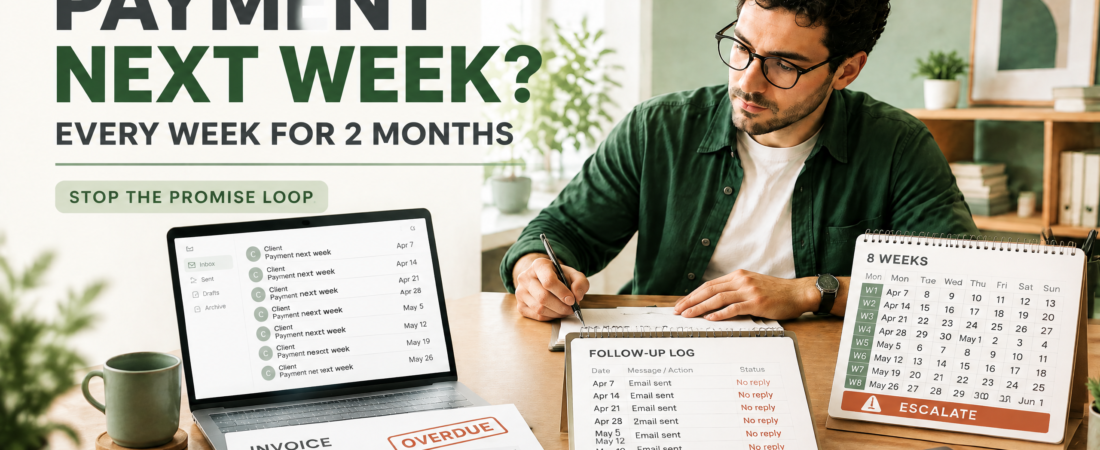
Have you spent the last eight weeks hearing “the transfer is scheduled for next Tuesday” while your bank account remains completely still?
When a client repeatedly promises payment but keeps moving the date, the problem is no longer simply an overdue invoice. You now have a documented pattern of broken payment commitments that requires a more structured response.
The safest strategy is not to threaten the client or assume that a promissory note will automatically make the debt enforceable everywhere. Instead, stop extending additional unpaid work, document exactly what is owed, confirm the client’s position in writing, and move toward a formal repayment agreement or legal demand where appropriate.
If the client genuinely owes the money, a written acknowledgment and clearly documented repayment schedule can be substantially more useful than another informal “I’ll pay next week” message.
Important: A promissory note, debt acknowledgment, late-payment interest, suspension of services, and withholding of deliverables can have different legal consequences depending on the contract, governing law, jurisdiction, and type of work. This article provides general information, not jurisdiction-specific legal advice.
Table of Contents
Quick Decision Matrix: What to Do When “Next Week” Keeps Moving
| Client behavior | Immediate strategic move | Main objective |
|---|---|---|
| First 1–2 missed promises | Send a written payment confirmation and deadline | Create a clean record |
| 3–4 broken promises | Pause additional discretionary work where your contract permits | Stop increasing your exposure |
| 60+ days overdue | Send a formal demand and propose documented repayment terms | Convert repeated promises into a defined resolution |
| Client acknowledges debt but needs time | Consider a written repayment agreement or promissory note | Establish dates, amounts and default consequences |
| Client disputes the invoice | Separate the disputed amount from undisputed amounts | Prevent a blanket refusal to pay |
| Client ghosts you | Escalate documentation and consider formal recovery options | Preserve evidence and limitation deadlines |
Before allowing an account to drift into Net 60 or beyond, review your Freelancer Payment Terms Guide: Avoid Net 60 & Late Payments and compare your existing terms with Net 15 vs. Net 30 vs. Net 45: Which Payment Terms Protect Your Cash Flow?.
The Promise Breakdown Protocol
When “next week” has become a repeating cycle, use this four-stage framework.
Step 1: Stop Increasing the Unpaid Exposure
Do not automatically continue producing additional billable work simply because the client promises that the old invoice will be paid next week.
Where your contract permits suspension, document the suspension professionally rather than simply disappearing.
See How to Use the Notice of Suspension of Services Without Ruining the Client Relationship Permanently for a structured approach.
If unpaid work is also being mixed with new requests, review Stop Working for Free: How to Prevent Scope Creep From Eating Your Profits and Client Asked for “One Quick Fix”? Here’s How to Charge for Scope Creep Without Losing the Client.
Step 2: Convert the Conversation Into a Written Record
When a client says:
“Accounting will pay Friday.”
Do not simply answer:
“Okay, thanks.”
Instead, create a contemporaneous written record confirming:
- invoice number;
- principal amount;
- original due date;
- amount already paid, if any;
- amount outstanding;
- promised payment date;
- whether the client disputes any part of the invoice.
If the relationship began without a conventional written contract, your documentation becomes even more important. See Can You Sue a Client Without a Contract? Real Legal Answer (2026) and Can a WhatsApp Chat Count as a Legally Binding Contract? (US & UK Law).
Step 3: Ask for a Defined Repayment Commitment
If the client cannot pay the entire balance immediately, ask for a concrete written repayment proposal.
Depending on the circumstances and applicable law, this could take the form of:
- a settlement agreement;
- a payment plan;
- a debt acknowledgment;
- a promissory note; or
- another written agreement documenting the obligation.
Do not assume that every document labelled “Promissory Note” has the same legal effect in every country.
Step 4: Escalate if the Promise Cycle Continues
If the client refuses to document the debt, repeatedly breaks new payment dates, or stops communicating, move from informal chasing to a formal recovery process.
Your next step may be a demand letter, mediation, collection process, arbitration, small-claims procedure, civil action, or another remedy depending on the governing law and amount involved.
For a broader recovery roadmap, see The Freelancer’s Legal Guide to Recovering Unpaid Invoices (Without Expensive Lawsuits).
1. Why “Payment Next Week” Becomes a Serious Warning Sign
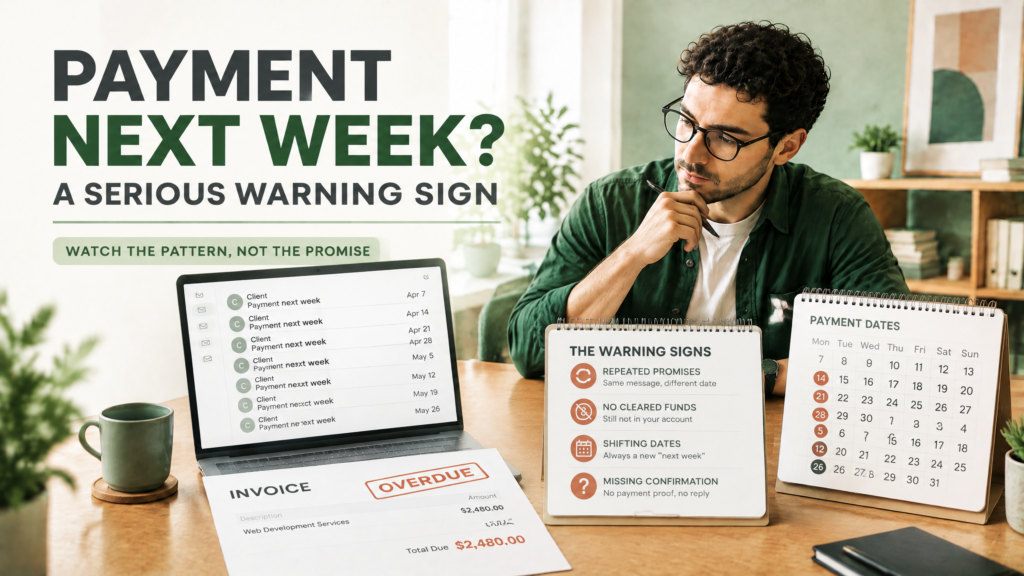
One missed payment date can be an administrative problem.
Eight consecutive missed payment dates are different.
If the client repeatedly gives you a new payment date without actually paying, stop treating each promise as a fresh event. Look at the pattern.
A useful question is:
Has the client provided a payment date, or has the client provided another reason to wait?
Repeated explanations such as:
- “accounts payable is processing it”;
- “the transfer is scheduled”;
- “the founder needs to approve it”;
- “our customer hasn’t paid us yet”;
- “the bank is holding the transfer”; or
- “we will definitely pay next Friday”
do not by themselves establish when you will actually receive the money.
If the client’s internal accounting process is becoming a recurring excuse, see Stuck in an “Accounting Loop”? Try This Psychological Trick to Get Paid Fast.
You should also distinguish an actual payment dispute from a simple delay. If the client suddenly alleges defects, missing deliverables, unauthorized expenses, or incorrect invoicing, preserve those communications instead of treating the matter as an ordinary late invoice.
2. First Determine Whether the Invoice Is Actually Disputed
Before demanding a promissory note, determine whether the client agrees that the amount is owed.
This distinction is critical.
Scenario A: The client admits the debt
Example:
“Yes, we owe you $14,500. Accounting will release it next Friday.”
That statement may be useful evidence of the client’s position, although its legal effect depends on the governing law and circumstances.
Scenario B: The client disputes the amount
Example:
“We owe you only $8,000 because the final milestone was not accepted.”
This is no longer merely a payment-delay problem. It is partly a contract or performance dispute.
Scenario C: The client claims the invoice was never received
Document delivery and resend the invoice through the appropriate channel.
For corporate clients, see:
What to Do When a Corporate Client Claims Your Invoice Was Lost in Accounting for the Third Time
and
Client Says Your Invoice Was Lost? How to Get Paid by Corporate Accounts Payable.
You can also strengthen future invoicing systems with How to Design an Invoice That Accounts Payable Teams Can’t Ignore.
3. Why Verbal Payment Assurances Should Be Confirmed in Writing
A phone call can be useful, but a written record is easier to organize and preserve.
After a call, send a short confirmation such as:
“Thank you for confirming today that invoice #1047 in the amount of $14,500 remains outstanding and that you expect payment to be processed on September 18. Please let me know immediately if any part of this summary is inaccurate.”
This approach does not magically create a binding agreement. Instead, it creates a contemporaneous record of what was communicated.
Keep:
- emails;
- Slack messages;
- WhatsApp conversations;
- invoices;
- purchase orders;
- contracts;
- acceptance messages;
- delivery records;
- Git commits;
- project-management records;
- payment confirmations; and
- bank statements.
For a deeper approach, see How to Turn an Email Trail into a Legally Defensible Invoice Statement.
If the only agreement was through Slack, review Client Ghosted Final Invoice But We Only Agreed Via Slack. Can I Sue?.
4. Should You Ask for a Promissory Note?
Sometimes.
But not automatically.
A promissory note can be useful where:
- the amount owed is clearly identified;
- the client acknowledges the obligation;
- the client needs additional time to pay;
- the parties want a structured installment schedule;
- the governing law recognizes the instrument; and
- the document is drafted consistently with the applicable legal requirements.
In U.S. commercial law, a note can qualify as a negotiable instrument if it satisfies the requirements of UCC §3-104, including an unconditional promise to pay a fixed amount, payable to bearer or order and on demand or at a definite time, subject to the statutory requirements.
Cornell Law School’s Legal Information Institute similarly explains that a promissory note is a written promise to pay money, but that not every note necessarily qualifies as a negotiable instrument under Article 3.
That distinction matters.
A promissory note is not a magic “debt eraser.”
Signing one does not automatically mean:
- every underlying dispute disappears;
- every defense is waived;
- every interest rate is enforceable;
- every acceleration clause will operate exactly as written; or
- the creditor can immediately obtain judgment without following the applicable procedure.
Those questions depend on the actual document and governing law.
5. What a Repayment Agreement Should Clearly Identify
If you decide to document a repayment arrangement, consider addressing:
The principal
State the exact amount acknowledged as outstanding.
The payment dates
Use specific calendar dates rather than phrases such as “next week.”
The installment amounts
Example:
- $5,000 on September 20;
- $4,750 on October 4;
- $4,750 on October 18.
Existing disputes
If any amount remains disputed, identify it instead of pretending that the entire account is undisputed.
Interest
Do not insert an arbitrary interest percentage simply because another freelancer used it.
The enforceability of contractual or statutory interest depends on applicable law and the agreement.
See Can You Legally Charge Interest on Late Invoices? (US, UK, & India Rules) and How to Charge Late Fees Legally (US, UK & India Guide).
Default
Specify what happens if an installment is missed, subject to applicable law.
Acceleration
If the parties intend the remaining balance to become due after a default, the agreement should state that clearly and the clause should be reviewed for enforceability under the governing law.
Release or settlement language
Be careful.
Do not accidentally release claims that you intended to preserve.
This is one reason a lawyer should review a significant repayment agreement.
6. The U.S. Position: Do Not Treat the UCC as a Universal Debt-Recovery Code
For U.S. readers, there is an important distinction between the Uniform Commercial Code and general contract law.
UCC Article 3 addresses negotiable instruments. It does not provide one universal answer to every freelance invoice dispute.
The UCC has also been adopted and modified through state law. Cornell’s UCC materials expressly note that the online version represents the version most widely adopted by states and that state enactments may differ.
Therefore, a freelancer should not read “UCC Article 3” and assume:
“My promissory note automatically gives me an easy judgment.”
It does not.
You still need to consider:
- governing law;
- forum;
- contract terms;
- defenses;
- procedural requirements;
- applicable limitation periods;
- whether the instrument is actually negotiable;
- and available enforcement procedures.
7. The UK Position: Late Commercial Payment Rules
The United Kingdom has a statutory framework for qualifying commercial late payments.
For qualifying business-to-business transactions, statutory interest can generally be claimed at 8% above the Bank of England base rate, subject to the statutory framework and the circumstances of the transaction.
Do not copy that rate into a U.S. or Indian contract.
Do not assume it applies to every transaction.
And do not assume statutory interest overrides a valid contractual arrangement without checking the applicable rules.
For UK readers, the safest approach is to verify the current rules and rate through the official government guidance before calculating a claim.
8. The EU Position: Late Payment Is Also Jurisdiction-Sensitive
The EU Late Payment Directive provides a framework for combating late payment in commercial transactions.
The Directive defines statutory late-payment interest as the relevant reference rate plus at least eight percentage points, subject to the Directive’s rules and national implementation.
The European Commission’s summary also identifies important remedies, including statutory interest and a minimum fixed compensation amount in qualifying circumstances.
However, freelancers should not treat “EU law” as if every Member State applies an identical debt-recovery procedure.
Always check the specific country’s implementation, contract and applicable law.
9. What About “Pay When Paid”?
A client may tell you:
“We cannot pay you until our customer pays us.”
That statement should not automatically be accepted as a legal defense.
The effect of a “pay-when-paid” or “pay-if-paid” clause depends on the contract wording and applicable jurisdiction.
Therefore, do not tell a freelancer:
“Your client has no legal defense.”
Instead:
- locate the payment clause;
- identify the governing law;
- determine whether the clause is actually a pay-when-paid or pay-if-paid provision;
- check whether the clause satisfies applicable law; and
- obtain jurisdiction-specific advice where the amount is significant.
For international transactions, also review How to Protect Yourself When Working With International Clients.
10. Should You Stop Working?
If the client is substantially overdue, continuing to generate additional unpaid work can increase your exposure.
But “stop working immediately” is not a universal legal rule.
First check:
- your contract;
- termination provisions;
- suspension rights;
- milestone obligations;
- notice requirements;
- client dependencies;
- deadlines;
- and applicable law.
If the contract allows suspension for non-payment, follow the contractual procedure carefully.
Your goal should be to create a documented, proportionate suspension, not to surprise the client.
See How to Use the Notice of Suspension of Services Without Ruining the Client Relationship Permanently.
11. What About Holding Back Code, Designs or Other Deliverables?
This is where freelancers need to be particularly careful.
Do not assume:
“They haven’t paid, so I can legally take their website offline.”
That can create a completely separate dispute.
The answer may depend on:
- ownership provisions;
- licensing terms;
- payment conditions;
- delivery obligations;
- possession;
- access credentials;
- third-party infrastructure;
- applicable copyright law;
- contract termination rights;
- and local remedies.
For example, withholding an unreleased PSD file under a contract may present a very different legal situation from shutting down a client’s production server.
See:
Client Asking for PSD Files Before Payment or AI Files Before Payment? Here’s What to Do
How to Revoke Access to Figma Files After Non-Payment (Safe & Legal Method)
and
Can I Shut Down a Client’s Server for Non-Payment? (Legal + Safe Method for Freelancers).
Do not use technical access as leverage unless you have carefully established that you are authorized to do so.
12. Evidence Checklist for a Repeated Payment-Promise Dispute
Create one chronological evidence folder containing:
Contract
The signed agreement, proposal, terms of service, purchase order or other governing documents.
Invoice
The original invoice and proof of delivery.
Work evidence
Include:
- Git commits;
- design files;
- project-management records;
- delivery emails;
- acceptance messages;
- staging links;
- time records; and
- other relevant evidence.
Payment promises
Save every written promise containing:
- “next week”;
- “Friday”;
- “after approval”;
- “after our customer pays”;
- “accounting is processing it”; or
- similar statements.
Non-payment evidence
Keep bank records and payment confirmations showing what was and was not received.
Dispute evidence
If the client later raises quality complaints, preserve the original complaint and your response.
Do not selectively save only favorable messages.
A complete record is generally more credible than a curated one.
For a practical documentation workflow, see Unpaid Invoice Follow-Up Email Templates (Day 1 to Day 30 System).
13. Evidence That Can Strengthen Your Position
Suppose your client writes:
“We know we owe the $14,500. We are waiting for our customer to release funds. We will pay you Friday.”
That communication may be useful evidence.
But its precise legal effect depends on the jurisdiction and circumstances.
Similarly, a client saying:
“We don’t owe the $14,500 because you failed to deliver milestone three.”
creates a materially different situation.
Do not treat all payment-related messages as debt acknowledgments.
The difference between:
“We owe you but need time.”
and
“We dispute owing you.”
can be crucial.
14. Illustrative Example: An $14,500 Balance With Eight Broken Promises
Consider a hypothetical example.
Marcus, a full-stack developer, completes a web application for a digital marketing agency.
The final invoice is:
$14,500
The contract provides:
Net 30
After the due date, the agency says:
“Payment will be released next Friday.”
Friday arrives.
No payment.
The agency then says:
“Next Friday.”
The same thing happens repeatedly for eight weeks.
At that point, Marcus should stop treating the matter as a routine invoice reminder.
A sensible escalation could look like this:
Week 1–2
Document the first missed payment promise.
Week 3–4
Confirm the amount outstanding and ask whether any part of the invoice is disputed.
Week 5–6
Consider suspending additional work if the contract permits it and provide written notice.
Week 7–8
Send a formal demand and propose a written repayment structure if the client acknowledges the debt but cannot pay immediately.
If the client refuses
Consider appropriate recovery options based on the governing law, including legal demand, mediation, arbitration, collection services or litigation where appropriate.
If the client instead begins using your work without payment, the situation may also involve separate contractual or intellectual-property issues. See What to Do When a Client Uses Your Work But Refuses to Pay You.
15. What If the Client Suddenly Claims Your Work Was Defective?
This is where many freelancers make a mistake.
The moment the client raises a quality dispute, stop treating the matter as a pure collection problem.
Create two columns:
| Payment issue | Performance issue |
|---|---|
| Invoice amount | Alleged defect |
| Due date | Alleged missed milestone |
| Payment promises | Requested correction |
| Amount paid | Amount disputed |
| Remaining balance | Evidence supporting complaint |
Then determine whether the performance complaint is:
- legitimate;
- already resolved;
- outside the agreed scope;
- raised for the first time after payment became overdue;
- or genuinely disputed.
For scope-related disputes, see Client Changed the Entire Project and Won’t Pay? Here Are 2 Ways to Kill Fee Strategy That Works.
For a client alleging a single unfinished feature, see The “Unfinished Feature” Trap: What to Do When a Client Demands a Full Refund Over One Bug.
16. Risk Matrix: When Should You Escalate?
| Risk | Client signal | Main concern | Reasonable next step |
|---|---|---|---|
| Low | One delayed payment with active communication | Administrative delay | Written reminder and confirmation |
| Moderate | Multiple broken promises | Pattern of non-payment | Formal written deadline |
| High | 60+ days overdue and no meaningful payment | Increasing recovery risk | Demand + documented escalation |
| Very high | Ghosting, hostility or disputed debt | Evidence and enforcement risk | Preserve records and obtain legal advice |
| Critical | Insolvency/bankruptcy indicators | Recovery may be impaired | Investigate insolvency status and applicable procedures |
If you suspect the client is financially distressed, read What Happens to Your Invoice If Your Corporate Client Goes Bankrupt?.
17. Do Not Threaten Legal Action You Do Not Intend to Take
A professional recovery message should be factual.
Avoid statements such as:
“Pay today or I will destroy your business.”
or
“I guarantee you will lose in court.”
Instead:
“If the outstanding balance is not resolved by [date], I will consider the contractual and legal remedies available to me.”
That is stronger because it is credible.
Collection communications should also avoid false or misleading representations about the amount owed, legal status of the debt, or consequences that are not actually available. U.S. federal debt-collection law contains specific restrictions on deceptive and unfair collection practices in covered consumer-debt situations.
Importantly, the federal FDCPA generally concerns consumer debts, not ordinary business debts. The FTC specifically notes that business debts are not covered by the FDCPA.
That is another reason not to casually tell every freelancer:
“The FDCPA protects you.”
It may not.
18. When a Debt Collection Agency Makes Sense
A collection agency may make sense where:
- the debt is well documented;
- the amount justifies the cost;
- the client is still operating;
- direct recovery efforts have failed; and
- you understand the agency’s fee structure.
Before assigning the debt, investigate:
- contingency percentage;
- upfront fees;
- litigation policy;
- geographic coverage;
- reporting practices;
- communication standards;
- dispute handling;
- and whether the agency actually handles commercial receivables.
See Should You Hire a Debt Collection Agency? (Real Cost, Risks & When It Actually Works).
Do not assume that hiring a collection agency automatically creates a legal claim that did not previously exist.
19. When Formal Legal Action Becomes More Reasonable
There is no universal “60-day rule” saying that every freelancer should sue on day 60.
The appropriate timing depends on:
- amount owed;
- contract;
- jurisdiction;
- limitation period;
- dispute status;
- evidence;
- arbitration clauses;
- collection costs;
- defendant solvency;
- and likely recoverability.
For a practical decision framework, see When Is It Officially Time for a Freelancer to Take Legal Action?.
If you decide to escalate, a formal notice can provide a final opportunity to resolve the matter.
See Final Notice Before Legal Action: Copy-Paste Script That Forces Payment.
For self-directed recovery, see How to Recover an Unpaid Invoice Yourself (Without Hiring a Lawyer).
20. What Government and Academic Sources Say
Use primary and academic sources when checking the legal principles behind your recovery strategy.
U.S. commercial paper
Cornell Law School’s Legal Information Institute provides the text of UCC §3-104 and explains the requirements for a negotiable instrument.
U.S. small-business contracting
The U.S. Small Business Administration explains that contract terms can specify payment procedures and that accurate invoices can help contractors receive payment more efficiently.
U.S. Small Business Administration — Contracting Guidance
U.S. debt-collection rules
The Federal Trade Commission explains that the FDCPA addresses abusive, unfair and deceptive collection practices involving covered consumer debts and specifically notes that business debts are not covered by the FDCPA.
Federal Trade Commission — Debt Collection
European Union late payments
EUR-Lex provides the primary text of Directive 2011/7/EU and its framework for statutory late-payment interest and commercial transactions.
These sources are more valuable than simply placing a list of legal URLs at the bottom of an article because the reader can see which source supports which proposition.
21. Interactive Tool: Promissory Note & Debt Recovery Calculator
Use this calculator to estimate the mathematics of a proposed repayment plan.
Important: This is a mathematical estimate only. It does not determine whether interest is legally recoverable, whether a particular interest rate is enforceable, or whether a promissory note is legally appropriate. Contract terms, statutory rules, jurisdiction and transaction type can change the result.
<div style="display: grid; grid-template-columns: 1fr 1fr; gap: 15px; margin-bottom: 15px;">
    <div>
        <label style="display: block; font-size: 0.85em; font-weight: bold; margin-bottom: 5px; color: #334155;">Unpaid Principal Amount:</label>
        <input type="number" id="principal" value="5000" min="0" step="0.01" style="width: 100%; padding: 8px; border: 1px solid #cbd5e1; border-radius: 4px; font-size: 0.95em;">
    </div>

    <div>
        <label style="display: block; font-size: 0.85em; font-weight: bold; margin-bottom: 5px; color: #334155;">Days Overdue:</label>
        <input type="number" id="daysOverdue" value="60" min="0" step="1" style="width: 100%; padding: 8px; border: 1px solid #cbd5e1; border-radius: 4px; font-size: 0.95em;">
    </div>

    <div>
        <label style="display: block; font-size: 0.85em; font-weight: bold; margin-bottom: 5px; color: #334155;">Illustrative Annual Interest Rate (%):</label>
        <input type="number" id="interestRate" value="10" min="0" step="0.01" style="width: 100%; padding: 8px; border: 1px solid #cbd5e1; border-radius: 4px; font-size: 0.95em;">
    </div>

    <div>
        <label style="display: block; font-size: 0.85em; font-weight: bold; margin-bottom: 5px; color: #334155;">Proposed Installments:</label>
        <input type="number" id="installments" value="4" min="1" step="1" style="width: 100%; padding: 8px; border: 1px solid #cbd5e1; border-radius: 4px; font-size: 0.95em;">
    </div>
</div>

<button onclick="calculatePaymentPlan()" style="background-color: #2563eb; color: #ffffff; border: none; padding: 10px 18px; border-radius: 4px; font-weight: bold; cursor: pointer; width: 100%;">
Generate Illustrative Payment Plan
</button>

<div id="calcResults" style="margin-top: 15px; padding: 12px; background-color: #ffffff; border: 1px solid #cbd5e1; border-radius: 4px; display: none;">
    <p style="margin: 5px 0; font-weight: bold; color: #0f172a;">Illustrative Interest: $<span id="calcInterest">0.00</span></p>
    <p style="margin: 5px 0; font-weight: bold; color: #0f172a;">Illustrative Total: $<span id="calcTotal">0.00</span></p>
    <p style="margin: 5px 0; font-weight: bold; color: #2563eb;">Illustrative Installment: $<span id="calcWeekly">0.00</span></p>
</div>

<p style="font-size: 0.85em; margin-top: 10px;">
<strong>Legal disclaimer:</strong> This calculator performs simple-interest arithmetic. It does not establish entitlement to interest, late fees, penalties, or any particular repayment structure. Verify the applicable law and contract before making a demand.
</p>

<script>
function calculatePaymentPlan() {
    var p = parseFloat(document.getElementById('principal').value) || 0;
    var d = parseFloat(document.getElementById('daysOverdue').value) || 0;
    var r = parseFloat(document.getElementById('interestRate').value) || 0;
    var n = parseFloat(document.getElementById('installments').value) || 1;

    var interest = p * (r / 100) * (d / 365);
    var total = p + interest;
    var installment = total / n;

    document.getElementById('calcInterest').innerText = interest.toFixed(2);
    document.getElementById('calcTotal').innerText = total.toFixed(2);
    document.getElementById('calcWeekly').innerText = installment.toFixed(2);
    document.getElementById('calcResults').style.display = 'block';
}
</script>
22. What If the Client Is Using Your Work While Refusing to Pay?
Non-payment can sometimes overlap with separate intellectual-property or licensing issues.
But do not automatically assume:
“They haven’t paid, therefore they have no right to use anything.”
Check the actual agreement.
Questions include:
- Was ownership transferred?
- Was a license granted?
- Was transfer conditional on payment?
- Was the work delivered under a work-for-hire arrangement?
- What jurisdiction governs?
- Has the client already received a license?
- Is the disputed material copyrightable?
- Is there a separate breach of contract?
For code-related disputes, see Client Stole My Website Code: What to Do — Legal Steps to Respond, Prove Ownership, and Recover Access.
For AWS-related disputes, see The Client Has Your Code on AWS and Won’t Pay: The Code-Audit Breakdown.
For creative work, see Client Used Your Design Without Paying? What to Do (Legal Guide for Freelancers).
Do not use copyright complaints or technical shutdowns merely as a substitute for an unpaid-invoice claim.
23. What If the Client Keeps Ignoring You?
If the client is active online but ignores your messages, resist the temptation to publicly shame them.
Instead:
- preserve the communications;
- send a professional written demand;
- identify the exact balance;
- provide a clear deadline;
- state the next lawful step you may consider;
- avoid exaggerated threats.
If they disappear completely after receiving the invoice, see My Client Ghosted Me After I Sent the Invoice—What Do I Do Now?.
24. How to Prevent the Next “Payment Next Week” Cycle
The best recovery strategy is prevention.
Consider:
- deposits;
- milestone billing;
- shorter payment terms;
- automatic reminders;
- late-payment provisions;
- suspension rights;
- clear acceptance procedures;
- IP-transfer conditions;
- change-order procedures;
- dispute procedures;
- and documented payment contacts.
If you work on a retainer, monitor the remaining balance before it reaches zero. See The Retainer Exhaustion Warning: How to Auto-Notify Clients When Their Balance Hits $0.
For clients who request additional legal or confidentiality obligations after the work is complete, see How to Handle a Client Who Retrospectively Demands an Uncontracted NDA Before Clearing an Invoice.
For early-payment incentives, see Early Payment Discounts for Freelancers: How to Get Clients to Pay 5 Days Early (Without Chasing Invoices).
Frequently Asked Questions
1. What should I do if my client says “payment next week” every week?
Stop treating each promise as a new payment solution. Confirm the amount owed and the promised date in writing, determine whether the invoice is disputed, stop increasing your unpaid exposure where your contract permits, and escalate to a formal demand or documented repayment arrangement if the cycle continues.
2. Should I ask my client to sign a promissory note?
A promissory note can be useful when the client acknowledges a debt but needs additional time to pay. However, it is not automatically the best document for every dispute. Consider the governing law, existing contract, disputed amounts, interest provisions and enforcement procedure before using one.
3. Does signing a promissory note eliminate the client’s ability to dispute the work?
Not necessarily. The legal effect depends on the wording of the document and applicable law. Do not assume that signing a repayment document automatically waives every contractual or performance defense.
4. Can I charge interest on an overdue freelance invoice?
Possibly, depending on the contract and applicable law. Some jurisdictions provide statutory late-payment interest, while contractual interest may be restricted by local rules. See Can You Legally Charge Interest on Late Invoices? (US, UK, & India Rules).
5. Can I stop working when my client has not paid?
Possibly, but check your contract first. Suspension rights, notice requirements, milestone obligations and applicable law can matter. See How to Use the Notice of Suspension of Services Without Ruining the Client Relationship Permanently.
6. Can I withhold my client’s files until payment arrives?
Do not assume that you can. The answer can depend on the contract, IP provisions, governing law and the type of deliverable. A freelancer should distinguish between withholding an unreleased deliverable and disabling a client’s live infrastructure.
7. What if the client says their own customer has not paid them?
Do not automatically accept or reject that explanation. Examine the contract for any pay-when-paid or pay-if-paid language and determine the applicable law.
8. Is an email promising payment legally enforceable?
An email can be important evidence, but whether it creates or proves an enforceable obligation depends on the facts and applicable law. It should not be described as automatically enforceable simply because it is written.
9. When should I send a final demand?
There is no universal number of days. A final demand becomes more appropriate when ordinary reminders have failed, the amount is clearly established, and you are prepared to take the next step identified in the demand.
See Final Notice Before Legal Action: Copy-Paste Script That Forces Payment.
10. What if the client disputes part of the invoice?
Separate the undisputed amount from the disputed amount, document the client’s objection, review the contract and supporting work records, and avoid presenting the entire balance as undisputed if it is not.
The Bottom Line
If a client promises “payment next week” for eight consecutive weeks, stop measuring the situation by promises and start measuring it by documented conduct.
Your practical sequence is:
Confirm the debt → document the promises → determine whether the invoice is disputed → stop increasing unpaid exposure where permitted → request a defined repayment commitment → use a written repayment agreement or promissory note where appropriate → issue a formal demand if necessary → escalate through the appropriate legal or collection process.
A promissory note can be useful.
A written acknowledgment can be useful.
A suspension notice can be useful.
A final demand can be useful.
But none of them should be presented as a universal legal shortcut.
The strongest recovery position is usually built from a clear contract, accurate invoices, evidence of performance, documented communications, legally supportable payment terms, and a disciplined escalation process.
For the broader recovery strategy, start with The Freelancer’s Legal Guide to Recovering Unpaid Invoices (Without Expensive Lawsuits).
Author
Adv. Sagar Haribhau Shirsat is an Indian advocate writing about freelance contracts, unpaid invoices, commercial documentation, digital-work disputes and practical debt-recovery strategy for independent professionals.
His work focuses on helping freelancers understand the documentation, contractual and procedural issues that can arise when clients delay or refuse payment.
Connect via his Official Professional LinkedIn Profile.
Disclaimer: This article is for general educational and informational purposes. It is not a substitute for legal advice tailored to the facts, governing law and jurisdiction of a particular dispute. Contractual rights, interest claims, promissory notes, intellectual-property rights, suspension of services and debt-enforcement procedures can vary substantially between jurisdictions. If a significant amount is disputed or legal proceedings are contemplated, consult a qualified lawyer in the relevant jurisdiction.
Last updated: September 11, 2026